How To Find Your Property On FEMA’s Flood Insurance Rate Maps

What are FEMA flood maps?
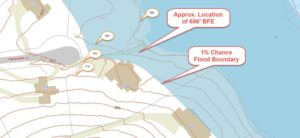
FEMA’s Flood Insurance Rate Maps (FIRMs) or just Flood Maps are provided after a flood risk assessment has been completed or updated for a community.  This study is known as a Flood Insurance Study.  The FIRM gives you the Base Flood Elevations (BFEs) and insurance risk zones in addition to floodplain boundaries.  The FIRM may also show a delineation of the regulatory floodway.

Once the “insurance risk zone”  (commonly referred to as the flood zone) is determined, actuarial rates, based on these risk zones, are then applied for newly constructed, substantially approved, and substantially damaged buildings.  FEMA uses these rates to determine the insurance rate you will pay for flood insurance

FEMA’s Digital Flood Maps

FEMA discontinued the production and distribution of paper flood maps in 2009 as part of its Digital Vision Initiative. This affected all the Flood Maps, boundary information, and study reports. However, clients can still view the products for free through their website or buy them in digital format.

To view these flood maps online, go to FEMA’s Map Service Center and key in your address (hi-lited area shown here) search for your home.  This will prompt you to then select the map that covers your area.  The Flood Maps are somewhat cumbersome to use online. It is best to go through the tutorial on the bottom right of the address search page for an easier and more effective use of the GIS map.

author avatar
Surveyor

More Posts

When You Need a Property Line Survey (And When You Don’t)

Most homeowners don’t think about property lines until something forces them to. One day everything feels fine. The next day, you’re planning a fence, talking to a contractor, or hearing a neighbor say, “I don’t think that’s your land.” That’s usually when people start searching property surveyors near me and

Read More »
Drone operator flying a survey drone at a construction site while capturing lidar data for project mapping
land surveying
Surveyor

LiDAR Checklist: Protect Deliverables When Suppliers Change

If your project depends on lidar, you probably care about one thing more than the sensor brand: you want clean files, on time, in the formats your team can actually use. That’s why recent headlines about a major LiDAR supplier going through bankruptcy and looking to sell its LiDAR business

Read More »
Aerial drone surveys view of rural farmland showing natural property lines and parcel boundaries
land surveying
Surveyor

Drone Surveys Reveal Errors in Old Property Lines

If you own land in rural areas, you might assume your property lines sit exactly where the old maps show them. But many parcels in our state were first measured in the early 1800s, long before modern tools existed. That is why drone surveys play a huge role today. They

Read More »
Aerial survey drone capturing land data over a modern city landscape
land surveying
Surveyor

Why Aerial Survey Tech Is Transforming Land Projects Today

Aerial survey technology is growing fast in 2025, and Cincinnati is one of the cities using it the most. Many people once thought an aerial survey was only for big construction jobs, but that is no longer true. Today, homeowners, builders, and developers use it because the data comes in

Read More »
A field technician uses modern surveying equipment to collect data that supports an accurate property survey
boundary surveying
Surveyor

AI Parcel Imaging May Boost Property Survey Requests

Cleveland is rolling out a new AI parcel imaging project, and many homeowners are already wondering what it means for them. The city will mount cameras on public vehicles and use software that scans properties for changes, damage, or possible violations. It’s fast, modern, and efficient. However, this new system

Read More »
A land surveyor using GNSS equipment in the field to collect accurate data for mapping and land surveying projects
land surveying
Surveyor

When GNSS Fails: Keeping Land Surveying on Track

In the world of land surveying, precision is everything. Surveyors depend on GNSS (Global Navigation Satellite System) tools to collect accurate data and verify control points. But what happens when those systems suddenly stop working? That’s exactly what many surveyors faced recently when OPUS, a popular online GNSS processing service,

Read More »