Most retaining wall projects look simple at first. Then construction starts. Suddenly there are surprises. Hidden slopes. Poor drainage. Features no one mapped. These problems cost money and slow everything down. A topographic survey done before design begins finds those problems early. Here is what it shows, and why it matters for developers.
Why Hidden Grade Breaks Can Change a Retaining Wall Design
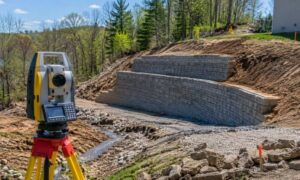
A topographic survey maps the elevation across a whole site. It finds small changes in the land that you cannot see just by walking around. Things like terraces, flat steps in a slope, and sharp drop-offs often stay hidden until a crew is already on site.
These hidden features matter. A sudden change in slope can affect how tall a wall needs to be. It can also shift where the wall goes. If the design does not match the real ground, the wall may not hold up over time.
Ohio has a lot of glacial soil. This type of soil creates uneven ground beneath the surface. A slope that looks gentle from the street may drop sharply just a few feet in. Survey data catches that. A site visit alone does not.
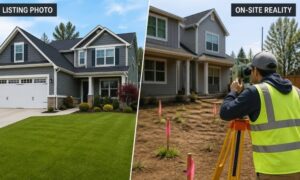
Getting accurate elevation data early means the wall design matches what is really there. That lowers the risk of structural problems after the wall is built.
Mapping Surface Water Paths Before They Become Retaining Wall Problems
Water is the top reason retaining walls fail. When water gets trapped behind a wall, pressure builds. Over time, that pressure causes cracks, movement, and collapse.
A topographic survey shows where water flows across a site naturally. It finds low spots where runoff collects. It also shows where water moves fast and where it crosses the area where a wall is planned.
That information shapes the drainage plan before work starts. Engineers use it to decide where to add drainage holes, whether a French drain is needed, and how to grade the land so water moves away from the wall.
Without survey data, drainage decisions are just guesses. On a sloped site, guesses are often wrong. The Ohio Department of Natural Resources reports that poor grading and drainage are among the top causes of slope failures in the state.
Mapping water paths early is one of the best ways to protect a retaining wall.
Existing Features That May Limit Retaining Wall Placement
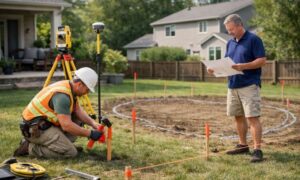
A topographic survey records more than elevation. It documents what is already on the site. Fences, driveways, utility boxes, drainage ditches, and large trees all affect where a wall can go.
This matters more than most people expect. A wall that blocks a drainage ditch creates a permit problem. A wall too close to a large tree can damage roots and make the wall unstable. A wall that blocks access to a utility structure will need to be redesigned.
Finding these issues during the survey phase avoids those problems. The design team can work around existing features from the start instead of discovering conflicts mid-construction.
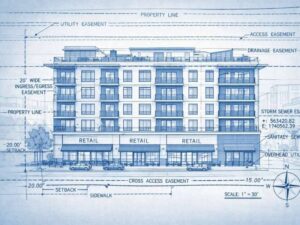
Ohio municipalities have different rules for utility setbacks and grading. Survey data helps confirm the design follows local rules before plans are submitted. That reduces permit rejections and saves time.
How a Topographic Survey Helps Evaluate Multi-Level Yard Improvements
Retaining walls are rarely built alone. Most are part of a bigger project. Patios, parking areas, outdoor spaces, and expanded yards often go in at the same time. Each of those improvements has its own elevation needs.
A topographic survey gives the accurate grade data that makes planning multiple improvements possible. Without it, things that should work together end up conflicting. A patio drains toward the house. A parking area slopes the wrong way. Steps between levels are too steep for code.
Accurate elevation data lets the design team see the full site before work begins. They can plan how each improvement connects to the next and where grade changes happen across the whole property.
For developers watching budgets, this matters. Redesigning one improvement because it conflicts with another is a cost that can be avoided. Survey data prevents it.
Preventing Costly Earthwork Surprises Before Construction Begins
Grading is one of the biggest cost variables in site work. How much soil needs to move, where it goes, and whether it can stay on site all affect the final price. Without survey data, those numbers are rough estimates at best.
A topographic survey gives the design team the information needed to calculate grading quantities before construction starts. They can see where soil will be cut, where it will be filled, and whether material needs to be brought in or hauled away.
That information changes project budgets in real ways. A site that looks like it needs little grading may actually need a lot of work to create a stable wall base. Finding that out during the survey phase costs far less than finding it out once equipment is already on site.
The American Society of Civil Engineers states that poor site data is one of the top reasons grading and earthwork projects go over budget. A topographic survey addresses that directly.